
Multi-Angle Spectrophotometer for Metallic and Effect Colors – BYK-mac i
A multi-angle spectrophotometer measures how a color changes when you look at it from different angles. The BYK-mac i from BYK-Gardner measures color at six angles and also measures sparkle and graininess, all in one reading.
What is a multi-angle spectrophotometer?
A standard spectrophotometer measures color from one fixed geometry (for example d/8° or 45°/0°). That works well for solid colors. It does not work for effect coatings.
Effect coatings contain aluminum flakes, mica, pearlescent or interference pigments. These pigments reflect light differently depending on the viewing angle. This is called goniochromism or the “flop” effect:
- Near the gloss angle (face), a metallic silver looks bright and light.
- Far from the gloss angle (flop), the same silver looks dark.
- Interference pigments can even change hue, for example from green to purple.
A multi-angle spectrophotometer (also written multiangle spectrophotometer) lights the sample at a fixed angle and measures the reflected light at several viewing angles – just as the eye sees a car door curve or a phone housing turn in the hand.
Why color alone is not enough: sparkle and graininess
Two metallic panels can have the same color values at every angle and still look different. The difference is the texture created by the flakes. A modern multi-angle spectrophotometer must measure color and effect together – exactly what the BYK-mac i was designed for.
Multi-angle color
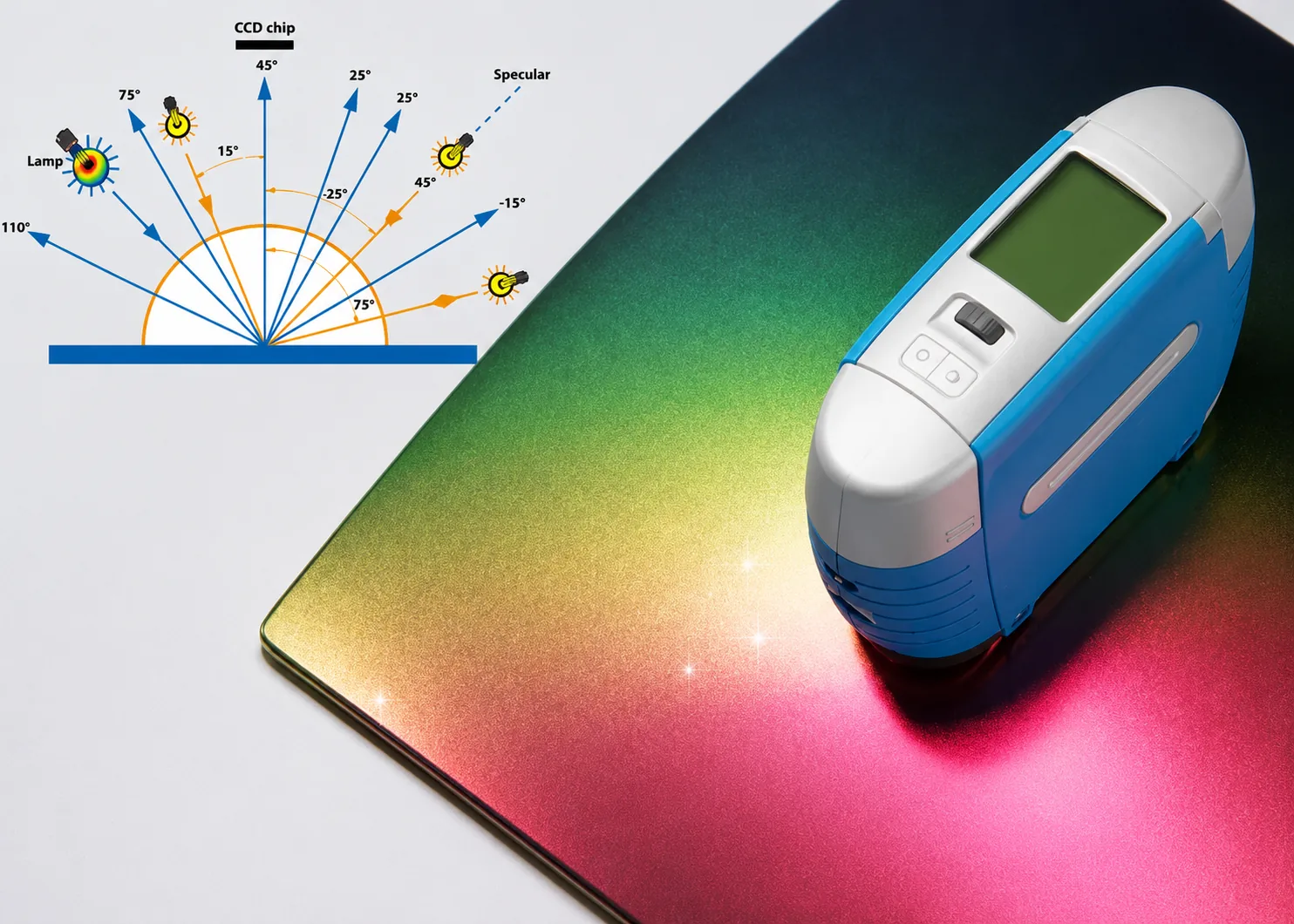
Color values at –15°, 15°, 25°, 45°, 75° and 110° describe the full color travel from face to flop.
Sparkle
The glittering points of light you see in direct sunlight. Measured with directional light at 15°, 45° and 75°.
Graininess
The salt-and-pepper pattern you see under diffuse light, such as on a cloudy day. Measured with diffuse illumination.
Products
BYK-mac i Multiangle Spectrophotometer
Choose the full color & effect version or the color-only version. Both include menu-guided operation and professional smart-chart software.
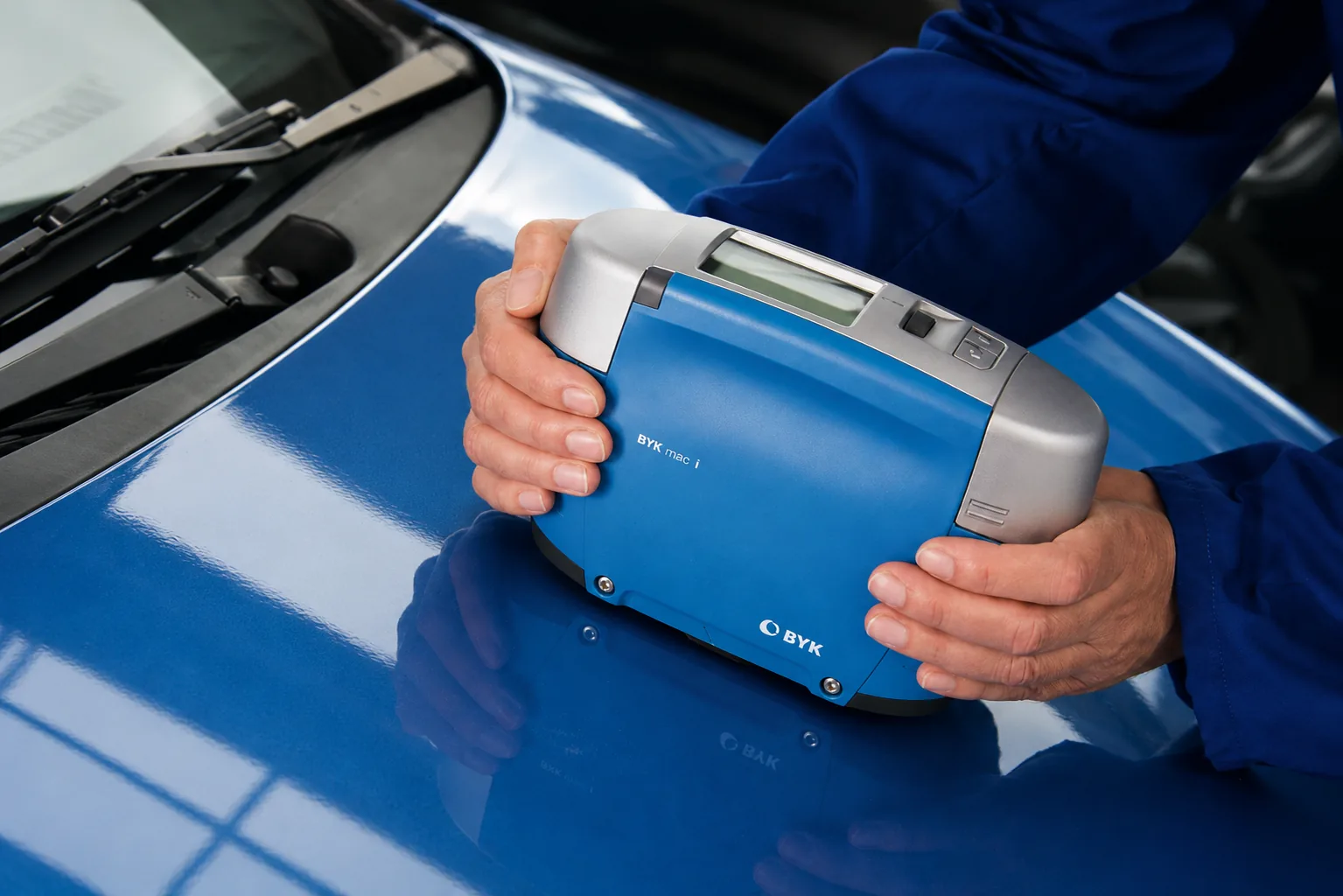
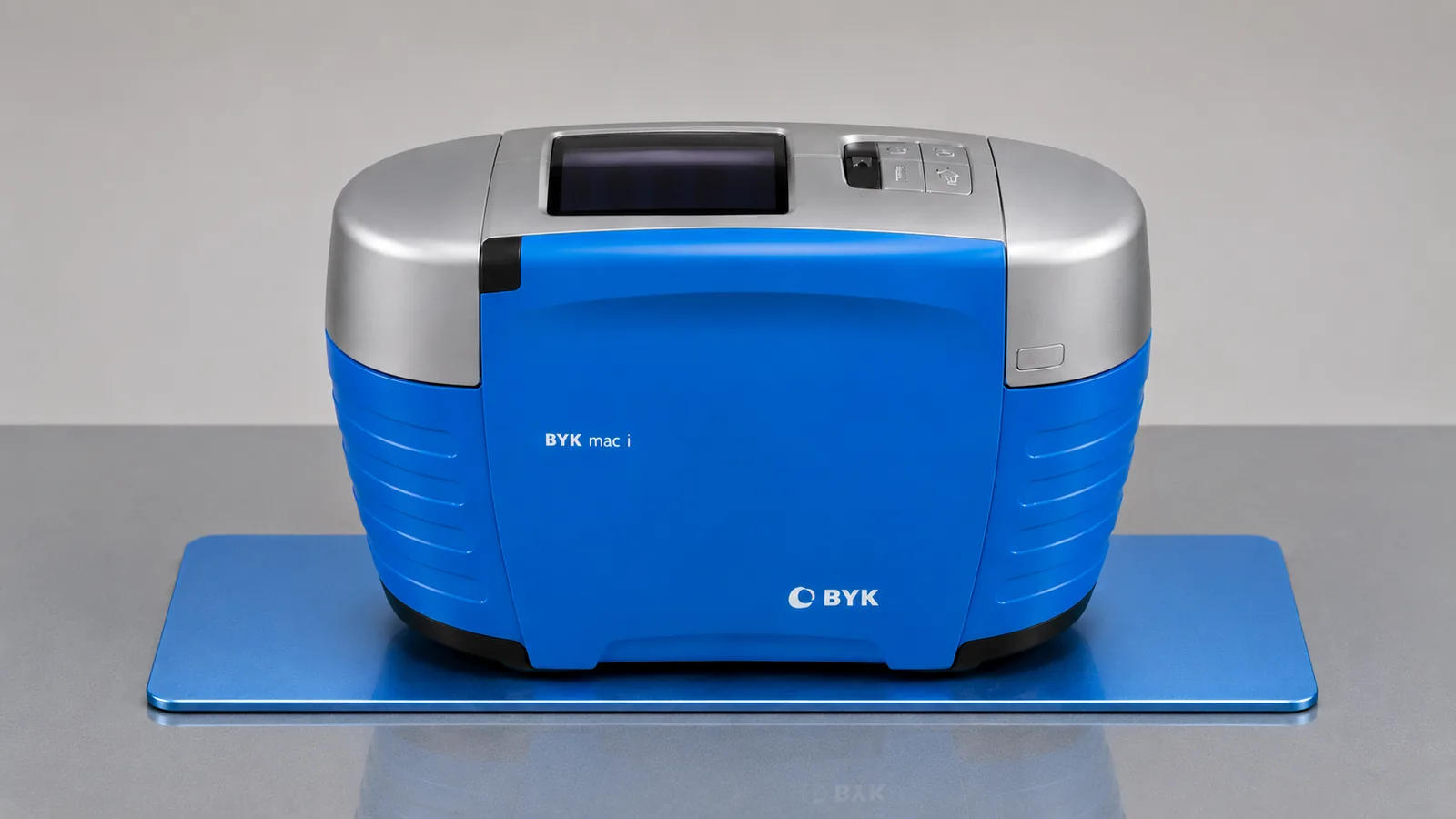
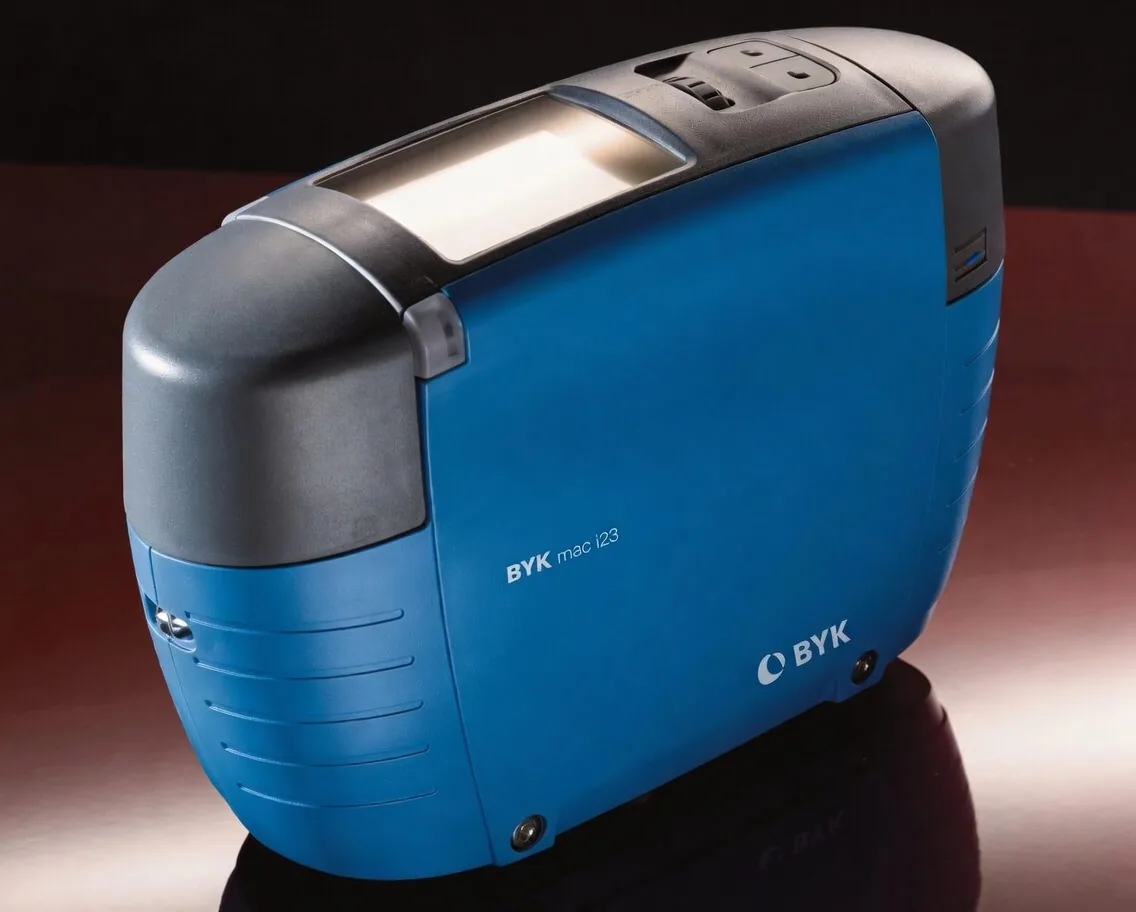
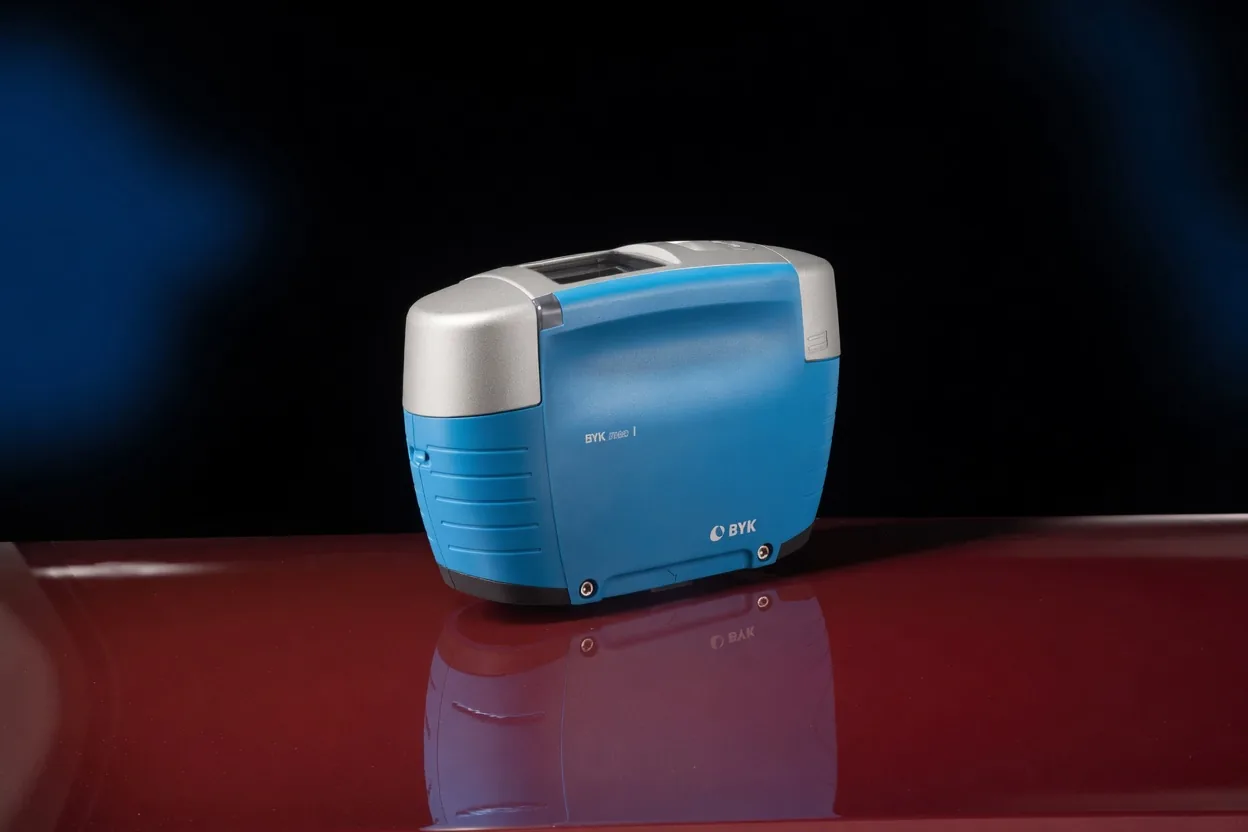
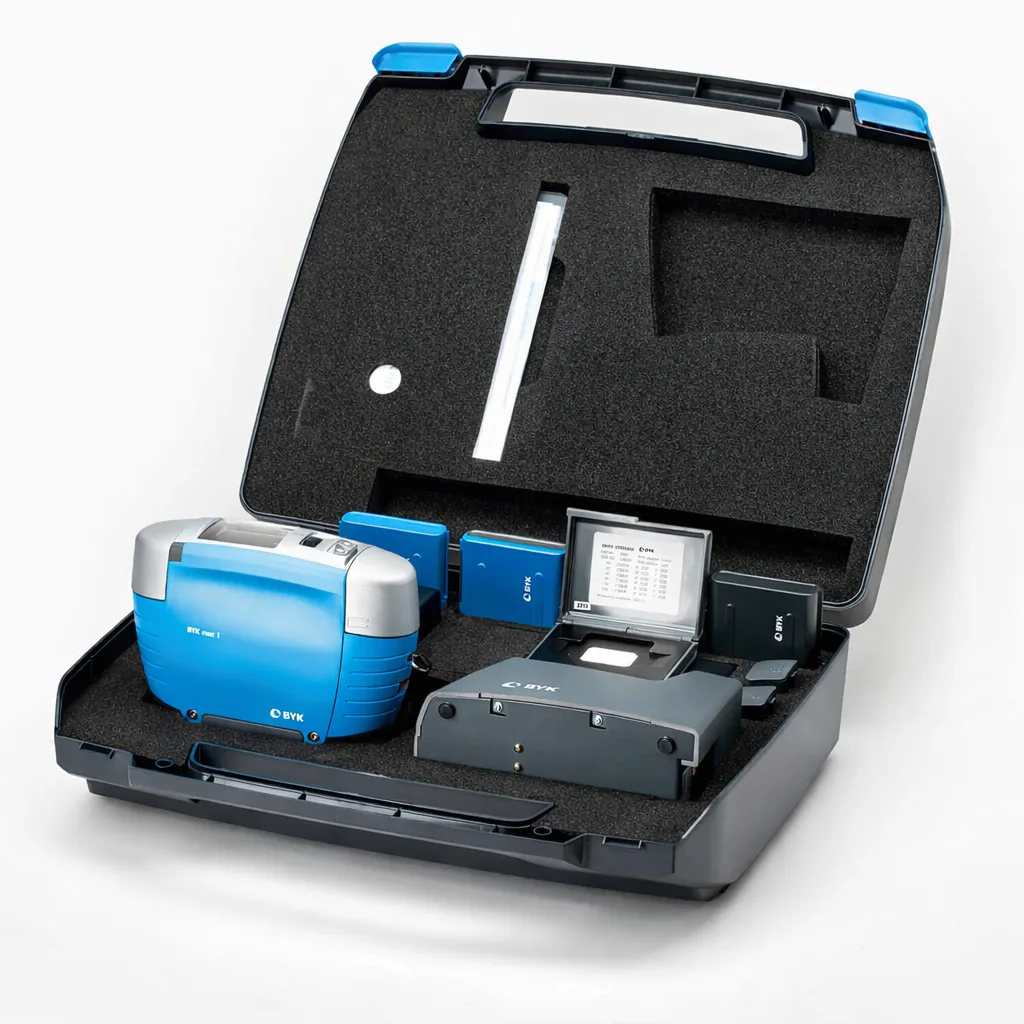
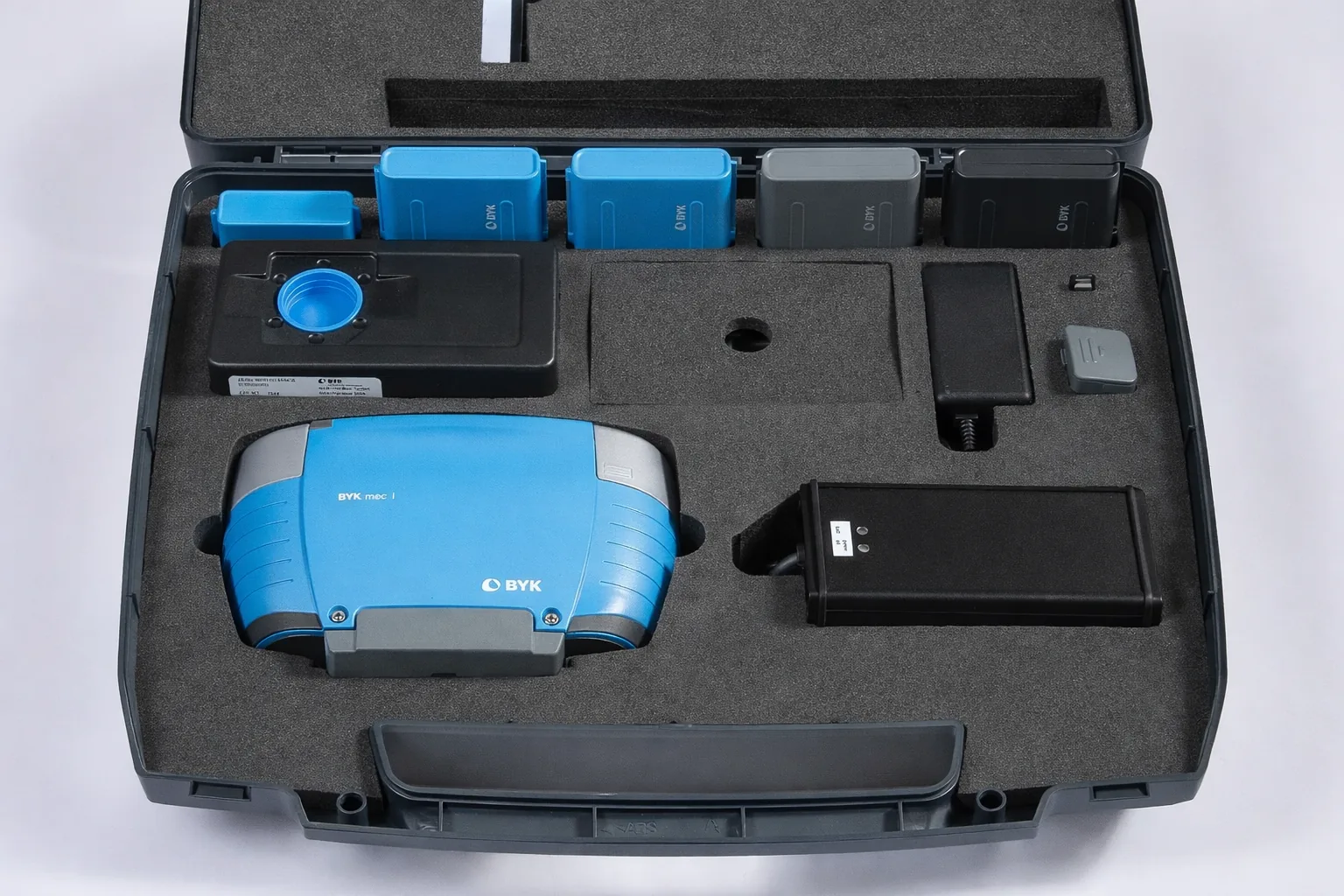
Multi-Angle Spectrophotometer including QC software
BYK-mac i 23 mm
Multi-angle color & effect measurement
- Measuring area: 23 mm diameter
- Menu guided operation according to your own sampling procedure
- Pass/Fail results displayed on the instrument for instant feed back at the line
- Professional data documentation and analysis with smart-chart software
| Category | Specification |
| Color Geometry | 45° illumination; -15°, 15°, 25°, 45°, 75°, 110° specular viewing |
| Measuring Area | 23 mm diameter |
| Spectral Range | 400–700 nm, 10 nm resolution |
| Measurement Range | 0–600% reflectance |
| Repeatability (Color) | 0.01 ΔE* (10 consecutive measurements on white) |
| Reproducibility (Color) | Grey BCRA II tiles: avg. ΔE* < 0.10; Chromatic BCRA II tiles: avg. ΔE* < 0.25 |
| Color Scales | ΔE*; ΔE CMC; ΔE 94; ΔE 2000; ΔE DIN6175-2019; custom scales |
| Color Indices | Flop, Int-Em |
| Illuminants | A, C, D50, D65, F2, F7, F11, F12, CIE 015:2018 LED illuminants |
| Observer Angles | 2°, 10° |
| Effect Measurement | |
| Effect Geometry | 15°, 45°, 75°, and diffused illumination; Perpendicular viewing with camera |
| Effect Parameters | ΔS, ΔSₐ, ΔSᵢ, ΔG |
| Repeatability (Effect) | Sₐ / Sᵢ: 5% or > 0.50 G = ± 0.05 |
| Reproducibility | Sₐ / Sᵢ: 10% or > 1.00 G = ± 0.15 |
| General | |
| Measuring Time | < 6 seconds |
| Memory | 1000 standards / samples |
| Display | 2.7 in TFT color LCD display |
| Languages | English, French, German, Italian, Japanese, Spanish, Chinese, Russian |
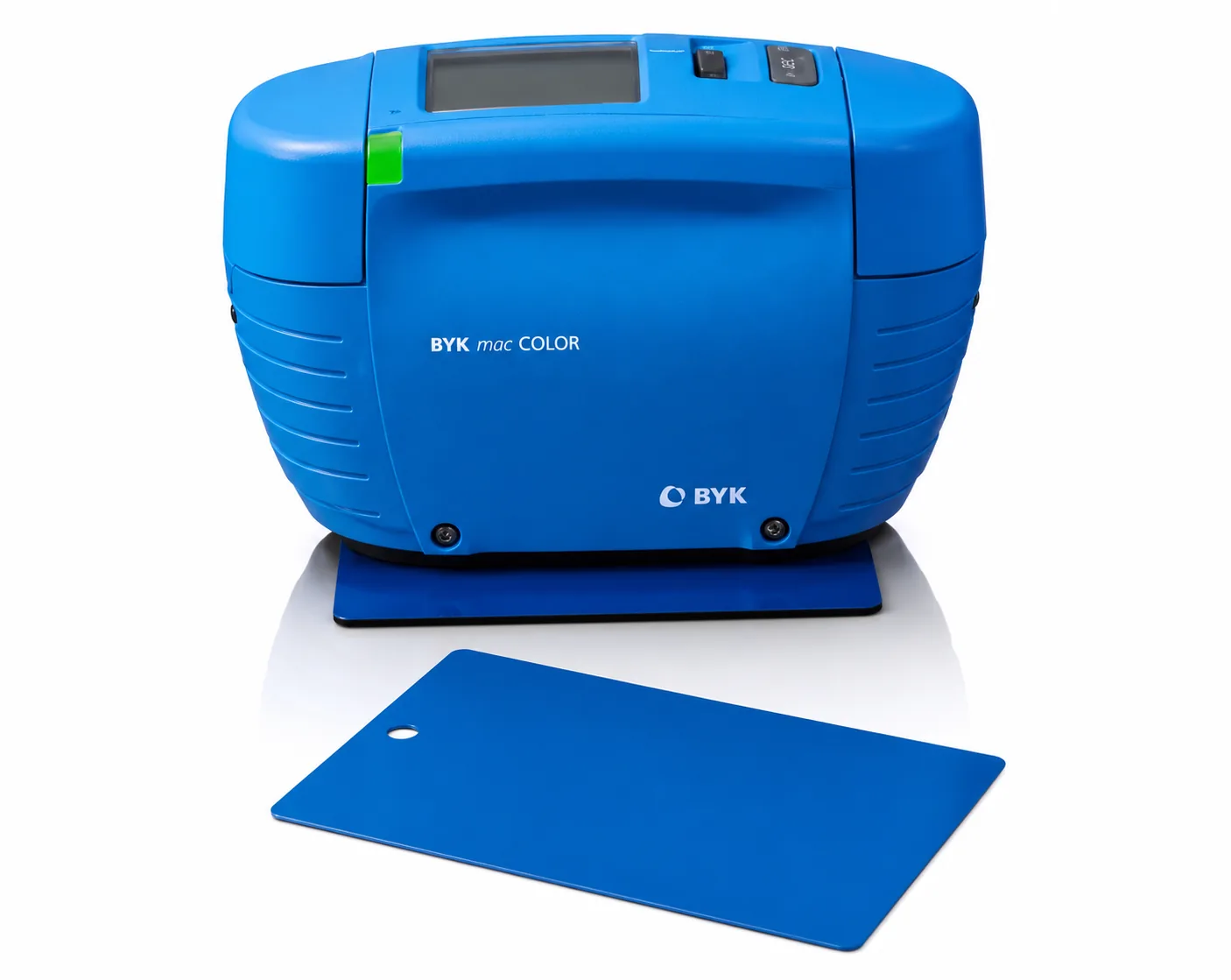
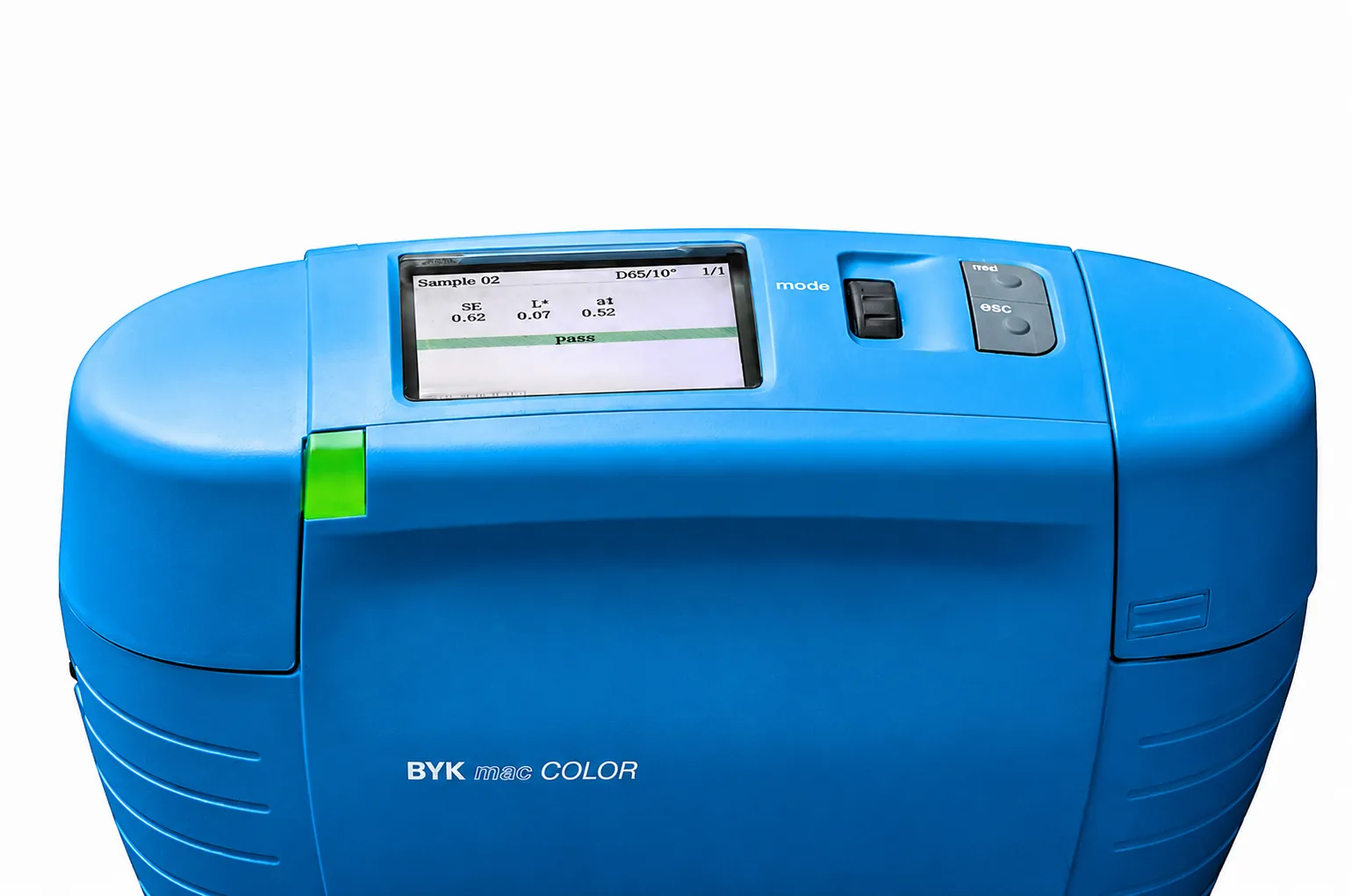
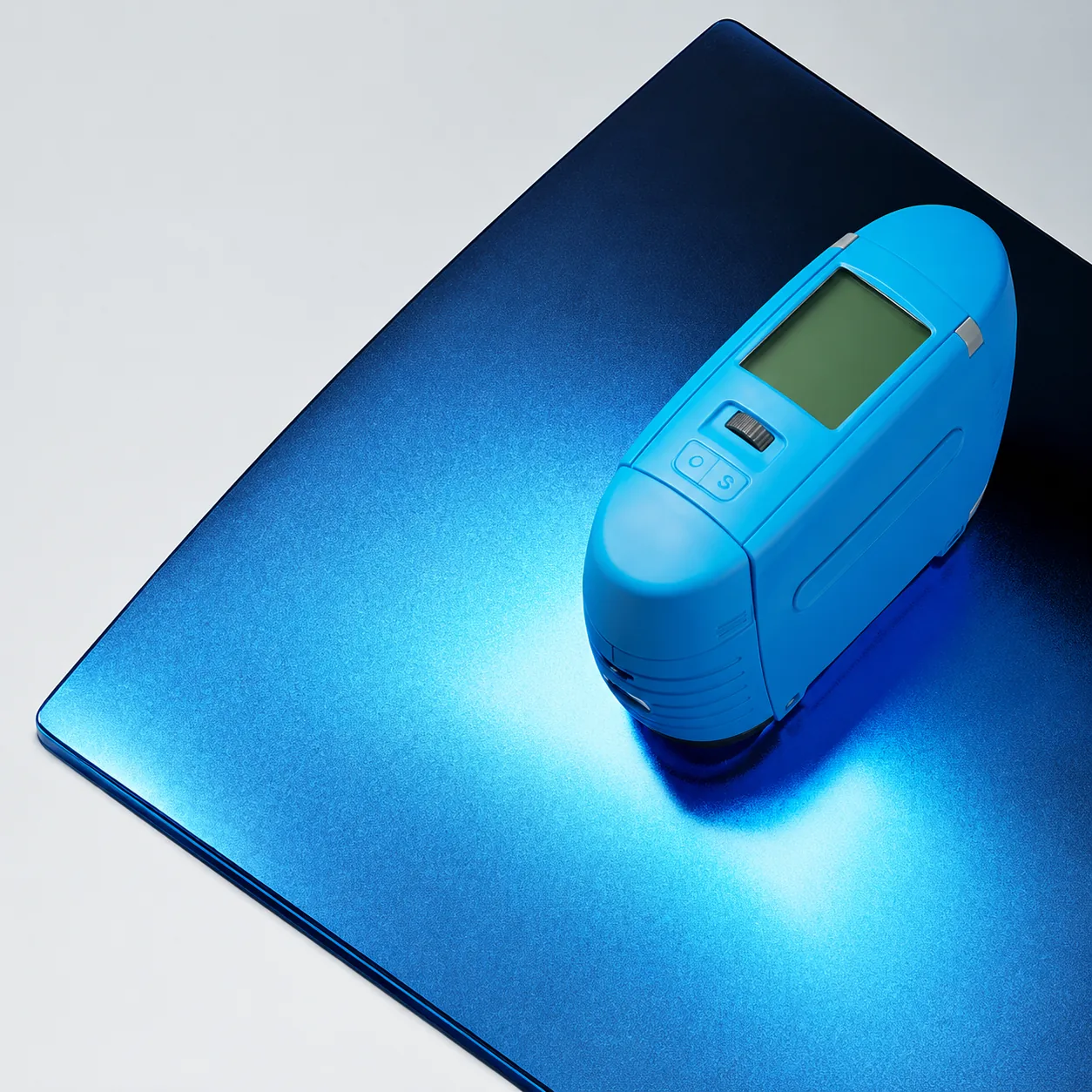
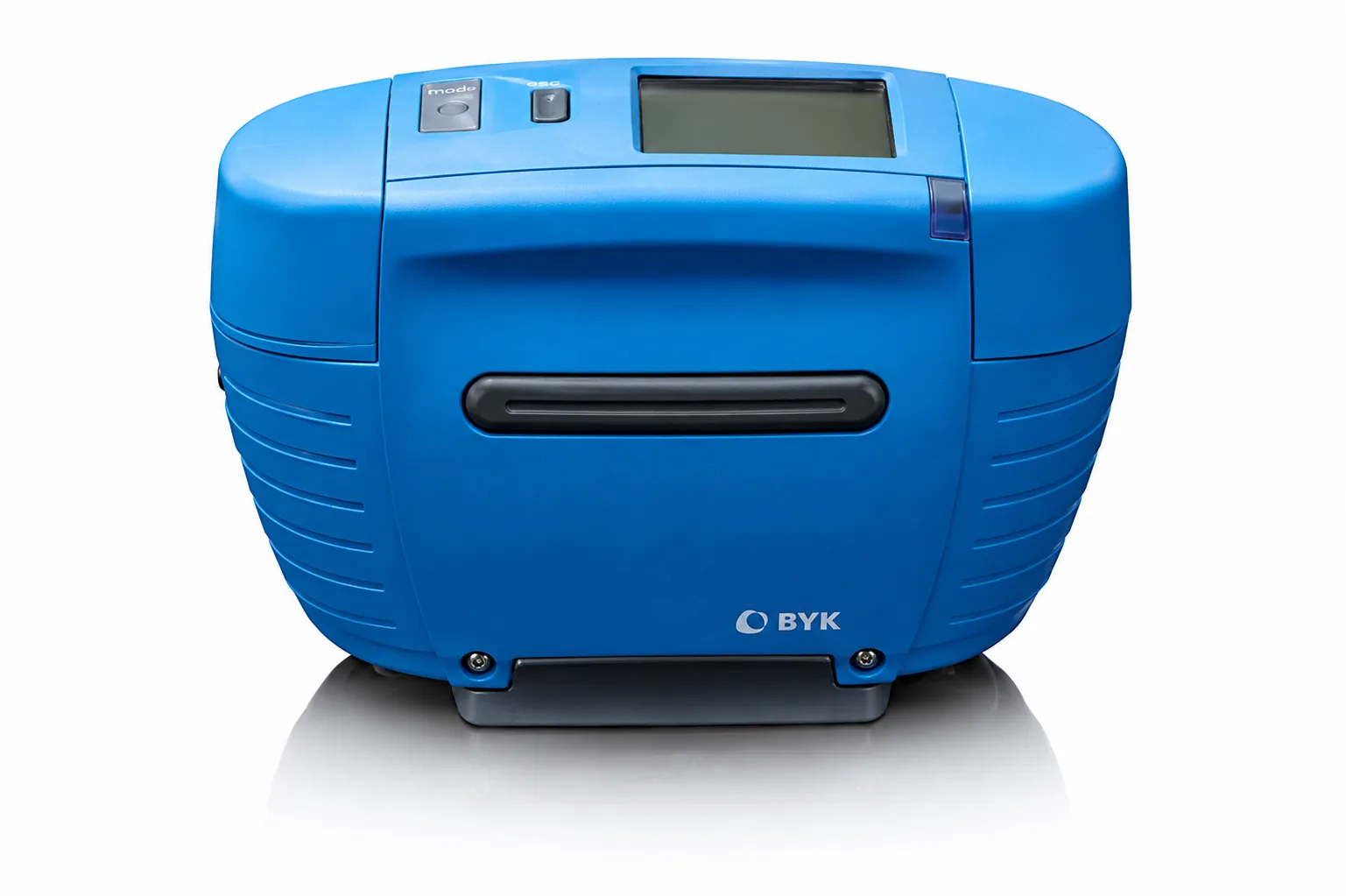
Multi-angle color measurement
BYK-mac i COLOR
Multi-angle spectro including software
- Measuring area: 23 mm diameter
- Menu guided operation according to your own sampling procedure
- Pass/Fail results displayed on the instrument for instant feed back at the line
- Professional data documentation and analysis with smart-chart software
| Category | Specification |
| Color Measurement | |
| Geometry | 45° illumination; -15°, 15°, 25°, 45°, 75°, 110° aspecular viewing |
| Measuring Area | 23 mm diameter |
| Spectral Range | 400–700 nm, 10 nm resolution |
| Measurement Range | 0–600% reflectance |
| Repeatability (Color) | 0.01 ΔE* (10 consecutive measurements on white) |
| Reproducibility (Color) | Grey BCRA II tiles: avg. ΔE* < 0.10 Chromatic BCRA II tiles: avg. ΔE* < 0.25 |
| Color Scales | ΔE*, ΔE CMC, ΔE 94, ΔE 2000, ΔE DIN6175-2019, customer specific scales |
| Color Indices | Flop, Int-Em |
| Illuminants | A, C, D50, D65, F2, F7, F11, F12, CIE 015:2018 LED illuminants |
| Observer Angles | 2°, 10° |
| General | |
| Measuring Time | < 4 seconds |
| Memory | 1000 standards / samples |
| Display | 2.7″ TFT color LCD display |
| Languages | English, French, German, Italian, Japanese, Spanish, Chinese, Russian |
What makes the BYK-mac i different from other multi-angle spectrophotometers
Many multi-angle spectrophotometers measure color at several angles. The BYK-mac i goes further: it was designed for daily quality control of effect finishes on real parts, in real production conditions. These are the advantages our customers value most.
Large 23 mm measuring area
Many handheld multi-angle instruments measure a spot of only 6 to 12 mm. The BYK-mac i measures a 23 mm area, so it averages many more effect flakes in one reading. A 12 mm version is available for small and curved parts.
Why it matters: fewer repeat readings and more representative results on coarse metallic and sparkle finishes.
Surface temperature in every reading
The BYK-mac i measures the surface temperature of the part and saves it with each measurement. Results stay stable from 10 °C to 40 °C without recalibration.
Why it matters: many pigments change color with temperature. You can tell a real color deviation from a warm part coming straight out of the oven.
10-year warranty on the LED light source
Long-life LED illumination with a 10-year warranty – no lamp changes. Calibration is needed only every three months.
Why it matters: lower cost of ownership, less downtime and fewer calibration interruptions on the line.
Fluorescence detection built in
Additional sensors detect fluorescent light in the visible range. The Intensity Emission (Int-Em) value quantifies it with every reading.
Why it matters: you catch batch differences caused by fluorescent pigments or additives that normal color values do not explain.
Trigger pins for operator-independent results
Pins on the measuring plate check contact with the surface. If the instrument is not placed flat, it shows an error instead of saving a wrong reading.
Why it matters: the same result whoever measures – on every shift and at every plant.
From handheld to robot with one technology
The BYK-mac i Robotic brings the same color and effect measurement to the robot arm, with results in under 6 seconds per measurement point. Instrument agreement allows digital standards to be shared across the supply chain.
Why it matters: lab, line, robot and supplier all speak the same color language.
Total appearance from one brand and one software
BYK-Gardner is also the reference for gloss and orange-peel measurement. With smart-chart software, color and effect from the BYK-mac i can be analysed together with BYK-Gardner glossmeter and wave-scan data – one supplier, one database, one report for the complete appearance of your finish.
Why it matters: customers judge color, sparkle, gloss and orange peel together. Now your QC can too.
Questions to ask any multi-angle spectrophotometer supplier
Use this list when you compare instruments. Here is how the BYK-mac i answers:
| Question | BYK-mac i |
|---|---|
| How large is the measuring area? | 23 mm (12 mm version for small parts) |
| Are sparkle and graininess measured in the same reading? | Yes – with 6-angle color |
| Is the sample surface temperature recorded? | Yes, with every reading |
| Is fluorescence detected? | Yes – Intensity Emission value |
| What is the warranty on the light source? | 10 years (LED) |
| How often is calibration needed? | Every three months |
| Is there a robot version with the same technology? | Yes – BYK-mac i Robotic |
| Can gloss and orange peel be analysed in the same software? | Yes – smart-chart |
Standards
The BYK-mac i supports the main color and appearance standards used in coatings and automotive quality control:
BYK-mac i models – which one do you need?
| Model | Measures | Best for |
|---|---|---|
| BYK-mac i 23 mm | Color at 6 angles + sparkle + graininess | Standard effect color QC on panels and car bodies |
| BYK-mac i 12 mm | Color at 6 angles + sparkle + graininess, small aperture | Small, curved or narrow parts: mirror caps, handles, trim |
| BYK-mac i COLOR | Color at 6 angles (no effect camera) | Multi-angle color control where texture is not critical |
| BYK-mac i Pro | Color + effect, for special surfaces | Anodized aluminum and demanding metal finishes |
| BYK-mac i Robotic | Color + effect, automated | Inline and robot-based measurement on the production line |
Not sure which version fits your parts? Send us a photo of your sample and we will recommend the right configuration.
smart-chart software: from data to decisions
All BYK-mac i instruments work with BYK-Gardner smart-chart software.
- Pass/fail tolerances for color and effect at every angle
- Trend charts to follow batches, shifts and suppliers
- Harmony checks between body and add-on parts (bumpers, mirrors, fuel doors)
- Clear PDF reports for customers and audits
Applications and industries
Automotive OEM & suppliers
Color harmony between painted bodies and plastic add-on parts from different suppliers and lines.
Automotive refinish
Check that repair paint matches the original finish at every angle, not only at 45°.
Paint & coatings
Batch release and formulation of metallic, pearlescent and effect paints.
Plastics
Molded-in effect colors for automotive interiors, electronics and appliances.
Effect pigments
Characterize aluminum, mica and interference pigments: color travel, sparkle, graininess.
Anodized aluminum
Color and effect control of anodized and coated metal parts (BYK-mac i Pro).
Packaging & cosmetics
Metallic inks, cosmetic packaging and premium product housings.
Consumer goods
Phones, appliances and sports equipment with metallic or pearl finishes.
Learn more on our Automotive, Paint & Coating and Rubber & Plastics industry pages.
How to choose a multi-angle spectrophotometer – checklist
- Number of angles – does it include –15° for interference pigments, or only 3 to 5 angles?
- Effect measurement – does it measure sparkle and graininess, or color only?
- Aperture size – can it measure your smallest and most curved parts?
- Inter-instrument agreement – will your plant’s readings match your supplier’s?
- Temperature control – is surface temperature recorded with each reading?
- Local support – is there a distributor for calibration, training and service in your region?
The BYK-mac i answers all five points – and INNOVLS covers the sixth.